
Dignitatis Humanae Revisited
An astute reader raises objections

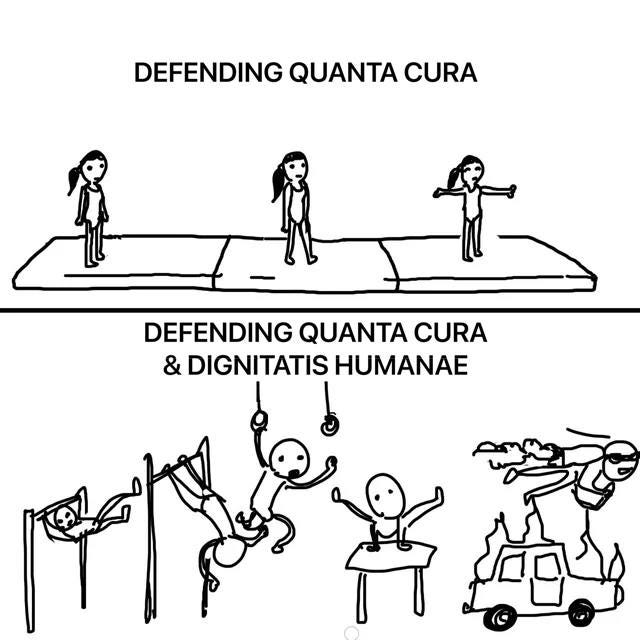
Above: a special meme created by the astute reader!
In light of my recent essay, in which I defended Dignitatis Humanae from the charge of contradicting Church Teaching, a dear friend with a sharp mind has raised some objections. The objections come from a respected writer and formidable critic of Vatican II: the late Michael Davies. They are good objections, and my response to them is instructive, which is why I choose to share them here.
The objections
The reader writes as follows, with brackets in bold indicating who is saying what:
[Reader] I am curious what you think of the Appendix II and III in Davies’ book. They are relatively short. Appendix II on page 272 covers the same propositions you did and he shares your conclusion.1 I also like how he ends Appendix III:
[Davies] In presenting the final draft of Dignitatis humanae, Msgr. de Smedt stated in his relatio:
[Msgr. de Smedt] Some Fathers affirm that the Declaration does not sufficiently show how our doctrine is not opposed to ecclesiastical documents up till the time of the Supreme Pontiff Leo XIII. As we said in the last relatio, this is a matter for future theological and historical studies to bring to light more fully. In the interest of strict historical accuracy the bishop should have included all the popes up to and including Pope Pius XII, and, to a large extent, Pope John XXIII. Almost thirty years have passed since Msgr. de Smedt made this statement, and no one has as yet made a coherent, let alone a convincing, attempt to reconcile the teaching of Dignitatis humanae with the traditional teaching of the popes. How the teaching of the Declaration can possibly be construed as a development of this citation from Vehementer nos is and must remain a mystery.
[Reader again] [Next, you] should tackle this [apparent contradiction]:
The Condemned Error Proposition 78 in the Syllabus of Errors states:78. Hence it has been wisely decided by law, in some Catholic countries, that persons coming to reside therein shall enjoy the public exercise of their own peculiar worship.
[But] Dignitatis Humanae states:
Provided the just demands of public order are observed, religious communities rightfully claim freedom in order that they may govern themselves according to their own norms, honor the Supreme Being in public worship, assist their members in the practice of the religious life, strengthen them by instruction, and promote institutions in which they may join together for the purpose of ordering their own lives in accordance with their religious principles.
Religious communities also have the right not to be hindered in their public teaching and witness to their faith, whether by the spoken or by the written word.
My response
Thanks for sending these additional comments. And how could I forget the timeless meme!
I think Davies is grasping at straws. [I perhaps came off too strongly here.]
Regarding Msgr. de Smedt’s comment that “the Declaration does not sufficiently show how our doctrine is not opposed to ecclesiastical documents up till the time of the Supreme Pontiff Leo XIII”, I would ask what, exactly, he thinks is missing. I see no contradiction—only a shift in emphasis. Of course you can always add more. But what exactly is missing that creates a tension? The passage from Davies doesn’t say.
Regarding condemned Proposition 78, it is clearly not in conflict with the quoted passage from Dignitatis Humanae (DH).
First, DH there allows that religious communities may honor God in public worship. It does not assert an unrestricted right to every public worship in every circumstance.
Second, Proposition 78 states that, in certain Catholic countries, it is not wise for the law to grant immigrants the public exercise of their particular form of worship. That is a judgment about prudence in a specific context—not a universal denial of religious liberty.
Most important, Proposition 78 begins with the word “Hence.” That word signals a conclusion drawn from the preceding Proposition 77, which reads:
In the present day it is no longer expedient that the Catholic religion should be held as the only religion of the State, to the exclusion of all other forms of worship.
Proposition 77 clearly concerns Catholic countries. Its language is carefully limited. If 78 follows from 77, then it too concerns Catholic countries. It is not a sweeping claim about every state or every instance of public worship. This is not special pleading. It is simply reading the text as it stands.
As our favorite monk neatly explains:
In the seventy-seventh censure the Pope denies that the principle of religious unity is less desirable now than formerly. The seventy-eighth censure declares it unwise, where unity of faith has never been shattered, to provoke dissension by authorizing the introduction and public practice of heretical worship. [emphasis mine]
The logic is straightforward. To suggest a contradiction, as Davies does, is to misread the structure and scope of the propositions.
Finally, it is worth noting that the practice of the Popes from the Middle Ages—a great topic for another occasion—all the way to the time of the Syllabus was to allow at least the monotheistic religions (Judaism, Islam) more leeway in the practice of their religious duties and worship, even public worship (within limits). So, we cannot suddenly interpret the Syllabus as condemning a practice of Christendom for centuries.
The reader means, I think, that Davies shares my conclusion about the consistency of Dignitatis Humanae with Quanta cura. Through several debates between Davies and Fr. Brian Harrison on these and related topics, the latter succeeded in convincing Davies that at least some of the apparent contradictions were merely apparent.