
Apologia pro Dignitatis Humanae
Vatican II's declaration on religious liberty

Above: “Pope Pius IX” by George Peter Alexander Healy (1871).
The next rule to be borne in mind, in order not to stumble in reading the Syllabus, is one that needs a touch of elementary logic to be understood. It is thus conveyed: “When a proposition is pronounced false, its contradictory is declared to be true; its contrary may be, or may not be, true.” I crave my reader’s forbearance for this bit of scholasticism; one word of explanation will make it as clear as noonday, and I really could not have left it out without loss…
Now, why have I intruded logic on my readers? Because, as I said, we cannot get on in the present case without it, and the neglect of the [rule] stated above, that “the condemnation of an opinion implies the truth of its contradictory, but not that of its contrary,” is at the bottom of more than half the misconceptions that have entered the heads even of well meaning people with regard to Pius IX.’s Syllabus.
Source: The Syllabus for the People: A Review of the Propositions Condemned by His Holiness Pope Pius IX, with Text of the Condemned List, by a Monk of St. Augustine’s, Ramsgate (London: Burns and Oates, 1874).
Introduction
Vatican II gets a lot of hate these days, and in traditional Catholic circles it is anything but fashionable to defend it. But I value truth more than trends. As a matter of plain fairness, if a criticism is unfounded, it ought to be answered—regardless of what else might be wrong with the target. In a previous essay, I defended Nostra Aetate from a common objection. Here I return to do the same for another Vatican II document: the Declaration on Religious Freedom, Dignitatis Humanae (DH).
When I was preparing to convert to Catholicism, some of my Reformed peers put a flurry of objections to me, hoping to dissuade me from crossing the Tiber. One was that DH contradicted previous Church teaching on religious tolerance and the duties of individuals and states toward the true religion—especially the teachings found in Pope Pius IX’s 1864 encyclical Quanta cura and its companion, the Syllabus Errorum.
The objection went something like this:
Objection
DH teaches that “the human person has a right to religious freedom,” meaning that no one may be coerced by any human authority to act against his beliefs in religious matters, within due limits (DH §2). DH also states that governments are to safeguard this freedom “by just laws and by other appropriate means” (DH §6). State coercion is permitted only to preserve “just public order.”
But Quanta cura condemned the following proposition:
The best condition of civil society is that in which no duty is recognized, as attached to the civil power, of restraining by enacted penalties, offenders against the Catholic religion, except so far as public peace may require. [emphasis mine]
Critics allege that DH actually affirms this condemned proposition by reducing all state concern for religion to a mere concern for peace. In other words, rightful authority (religious or not) can only get involved where public order is under threat.
Even if DH didn’t explicitly affirm the condemned proposition, critics say it adopts a political principle that amounts to the same thing: it strips the state of any positive duty toward religious truth. That, they argue, contradicts the perennial Catholic teaching that the state, as a moral agent, has an obligation to favor the true religion and can restrain public offenses against it—not only for public order, but for justice and the common good.
Response
This objection initially struck me as serious. If Vatican II had really taught what an earlier pope had condemned, then the Church’s claims about doctrinal consistency would be hard to maintain.
But the more I read, the weaker the alleged contradiction became. My peers not read Pius IX. They had not even read DH. Ultimately, they had allowed their emotions to get the upper hand. Their reactions to Vatican II—influenced by popular media, poorly run parishes, and numerous abuses—blinded them from seeing any possible continuity with earlier teachings.
To test an alleged contradiction, the method is simple. Applied to the present topic, it comes down to three questions:
What proposition was actually condemned in Quanta cura?
What is the logical distinction between a contradictory and a contrary?
Does Dignitatis Humanae affirm or imply the condemned proposition?
Once these are clarified, the objection falls apart.
1. Identify the whole proposition condemned (not a fragment).
The passage from Quanta cura does not simply condemn the idea that “public peace” is the only legitimate concern of the state in religious matters. It condemns something broader: the evaluative thesis that “the best condition of civil society is one in which the state recognizes no duty to restrain offenses against the Catholic religion, except so far as public peace may require.” That proposition is not just a denial of duty but rather an endorsement of a liberal order that excludes religion from civil concern.
2. Distinguish contradiction from contrariety.
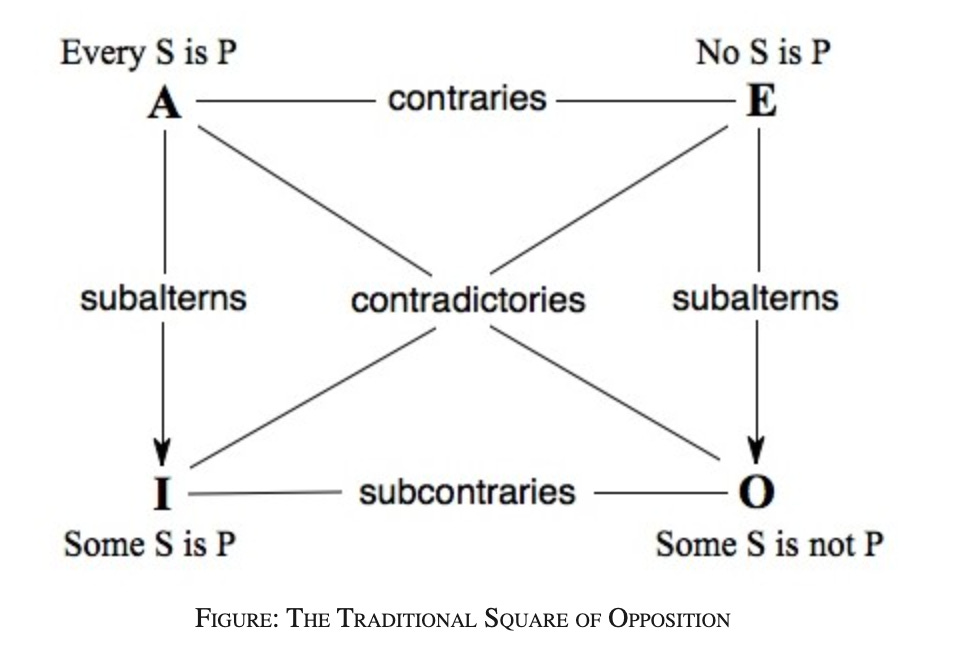
These distinctions have been known at least since Aristotle and are visualized in the ancient square of opposition. If two statements contradict each other, that means both cannot be true and both cannot be false; one must be true, and the other false. For example, the contradictory of “all banks close on Sunday” is not “no banks close on Sunday” but rather “not all banks close on Sunday”, which is the same as “some banks do not close on Sunday.”
By contrast, if two statements are contraries, that means both cannot be true but both can be false. So, “all banks close on Sunday” and “no banks close on Sunday” are contraries. Both cannot be true, but both could be false if some banks open on Sunday:
In short; one sentence is said to be contradictory to another when it conveys just as much as is [needed], and no more than is [needed], to affirm the falsehood of the opposite one.1
Now, when a proposition is condemned, its contradictory is affirmed—not its contrary. The contradictory of “this is the best condition of civil society” is “this is not the best condition of civil society.” Likewise, if the condemned claim is “no duty ever exists,” the contradictory is “some duty exists at some time.” You do not affirm the contrary—that is, the maximal opposite—merely by rejecting the original thesis.
3. Ask whether DH affirms or implies the condemned proposition.
It does not. DH explicitly states that it does not alter the Church’s perennial doctrine on the duties of individuals and societies toward the true religion. It leaves untouched the traditional Catholic teaching on the moral duty of men and societies toward the true religion and toward the one Church of Christ” (DH §1), but expounds “on the doctrine of recent popes on the inviolable rights of the human person and the constitutional order of society” (DH §1).
DH does not state or imply that “the best condition of civil society is one in which the state recognizes no duty to restrain offenses against the Catholic religion.” DH merely teaches that all people have a civil right to be free from coercion in religious matters, within “due limits.”2 That right is rooted in human dignity, not relativism, and it is known by reason and affirmed by revelation (DH §2).
Even if you rewrote the condemned thesis in Quanta cura to say, “there is no duty of the state to restrain religious offenses except for peace,” then its contradictory would simply be: “there is some duty beyond that.” But that does not imply the state must coerce, always or everywhere. And it certainly does not mean that DH affirms indifferentism or naturalism, which are the targets of Pius IX in Quanta cura. In short, DH neither states nor implies that civil government has no duty toward religion beyond public peace. It says that, whatever duties a state may have in relation to the true religion, it must not coerce religious belief or practice—except within the bounds of just public order.
DH is focused on a specific question: the right of persons to be free from coercion in matters of religious conscience and practice. That is the level at which its teaching operates. Penal restraint, as mentioned in Quanta cura, may be coercive in a broad sense, but DH is addressing coercion in a far narrower sense—coercion that compels or forbids religious action against conscience, outside the requirements of a just public order. Hence, penal restraint as such is not the coercion that DH has in mind.
When we attend to these distinctions—between restraint and coercion, contradiction and contrariety, right and duty—we see the alleged contradiction dissolve.
The Syllabus for the People: A Review of the Propositions Condemned by His Holiness Pope Pius IX, with Text of the Condemned List, by a Monk of St. Augustine’s, Ramsgate (London: Burns and Oates, 1874), 22-25. Available here. The author continues:
For example, if I read this sentence: “All the Catholic members of the House of Commons voted for the disestablishment of the Irish Church;” its contradictory might be thus formulated: “Not all the Catholic members voted for disestablishment.” The latter does not state that many members or even that more than one member withheld his vote; it simply denies that all voted. Between two contradictions there is no medium; if one is true, the other is false; and hence when a sentence is condemned as false, its contradictory is thereby defined as true.
But it is otherwise with two contrary propositions. Propositions are said to be contrary when one not only asserts the falsehood of the other, but affirms more than was necessary to make its opposite false. Thus, these two propositions: “All the members voted,” “None of the members voted,” are said to be contrary; the second denies a great deal more than was required to falsify the former. Between contraries there is a medium; it may be that some members did, some did not vote; hence both of two contraries may be false; though both cannot be true. I hope I have made clear what schoolmen mean by the two kinds of opposition in sentences; to wit, contrary and contradictory opposition.
The due limits are respect for the rights of others, public peace, and public morality.